


































English
English
中文
Damping Sound Insulation Sheet (Single-Sided Aluminum Foil) - SoundBox
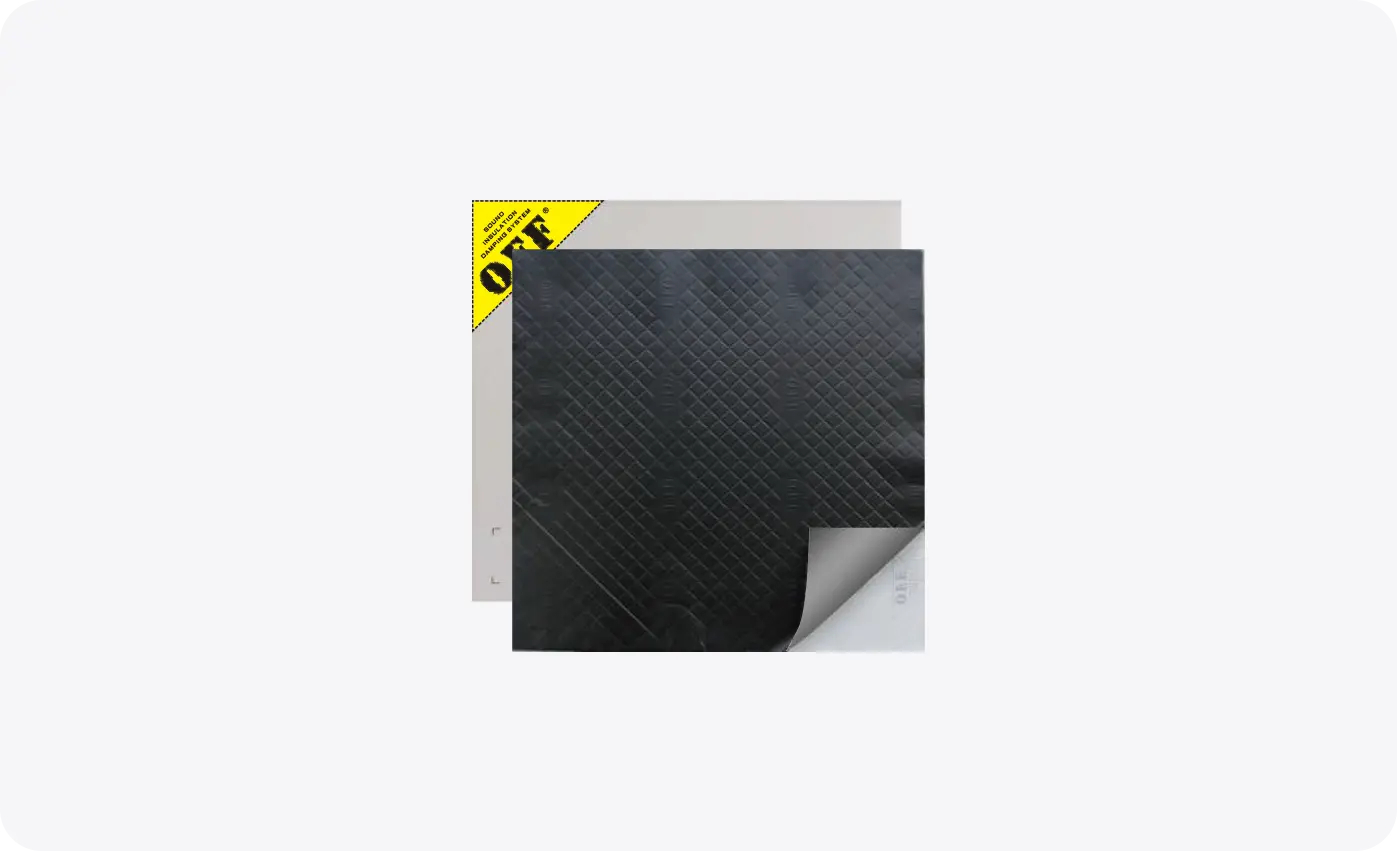
F100B / F150Ei / F200Ei
Damping Sound Insulation Sheet (Single-Sided Aluminum Foil)
Used for pipeline wrapping to enhance the sound insulation and noise reduction performance of PVC pipe walls; and for enhancing the sound insulation of metal damping and vibration-stopping materials in soundproof covers, engineering machinery, car compartments, ship cabins, and engine compartments.
- Model:
F100B/ F150Ei/ F200Ei
- Density:
3.8kg/㎡
- Weight:
F100B 28.95kg/20pcs 、F150Ei 28.3kg/20pcs 、F200Ei 29kg/20pcs
- Specification:
F100B 610mm x 610mm x 2.0mm 、F150Ei 610mm x 610mm x 1.5mm 、F200Ei 610mm x 610mm x 2.0mm
- Area:
0.3721㎡
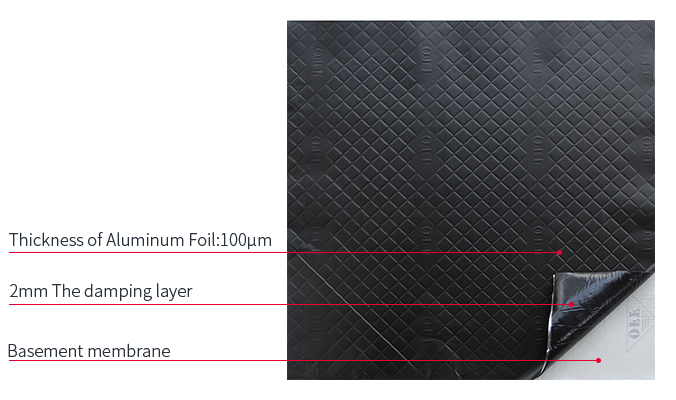
- Structure:
- Installation:
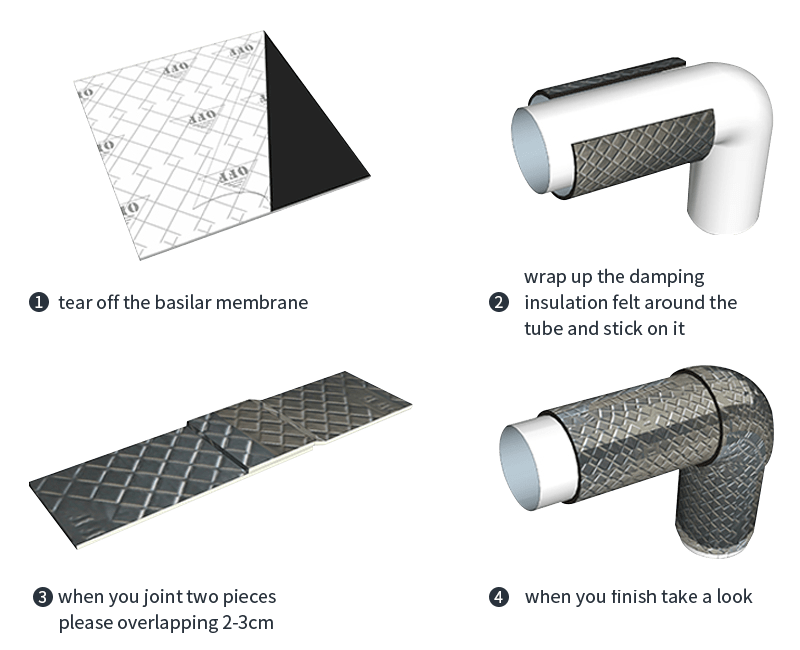
- Application Method:

- Applicable:
Applied to pipe wrapping to enhance the sound insulation and noise reduction performance of PVC pipe walls. Used for sound insulation enhancement in metal damping/vibration-dampening structures such as acoustic enclosures/hoods, engineering machinery, automobile cabins, ship compartments, and engine rooms. Applied by bonding to the surface of sheet metal materials to lower the resonance frequency, achieving vibration damping and noise reduction. Used in conjunction with underlayment on metal floors to effectively boost impact sound and airborne sound insulation performance of the floor slab.
- Feature:
IIR Polymer Acoustic Damping Sheet is a high-performance, eco-friendly soundproofing solution offering superior transmission loss and wide-band damping for structures and equipment prone to resonance. Utilizing a renewable, halogen-free IIR polymer base (density $\mathbf{4.2 \text{ kg/m}^2}$), this $\mathbf{2mm}$ composite sheet effectively dissipates sound energy and alters vibration frequency, boosting substrate sound reduction by $\mathbf{\ge 270\%}$. Ultra-flexible, with a strong self-adhesive backing for easy application (e.g., pipe wrapping, vehicle cabins, metal floors), it complies with international VOC standards, is free of harmful substances, and provides excellent durability and fire resistance.

The damping sheet uses stable IIR polymer as the base material, with heavy mineral fillers added to enhance the damping effect. IIR is widely recognized as the optimal environmentally friendly damping and acoustic insulation material.
Resonance is dependent on the material's stiffness and thickness. Resonance occurs when sound is transmitted through a structure or matches the natural frequency of a panel. Stiff, thin metal studs/frames and panel materials are typically prone to passive resonance.
Broad, monolithic surface structures are often the root cause of resonant sound transmission, as noise utilizes these material properties and structures for propagation.
The significant damping properties of IIR can alter the resonant effect of the original base material, resulting in excellent wide-band damping and acoustic insulation performance.
We believe that success project comes with success team
Start your project today
The sales team is here to help